Campus Safety Monitoring: How AI Detection and Panoramic Vision Support Safer Schools

June 11, 2026

Share this article

Campus Safety Monitoring

Schools are places for learning, growth, and community. From classrooms and hallways to playgrounds, entrances, parking areas, and sports facilities, a campus is often an open environment where students, teachers, staff, visitors, and parents move through the same space every day.


However, campus safety has become an increasingly important concern for many schools. Incidents such as student conflicts, bullying, unauthorized access, teacher-student disputes, vandalism, and emergency situations can happen quickly. In many cases, the challenge is not only how to respond, but how early the school can understand what is happening.


Traditional surveillance systems can help record events, but they often provide fragmented views. A fixed camera may only capture one direction, while critical activity may happen near a hallway corner, entrance, stairway, playground edge, or crowded common area. When an incident occurs, school staff may need to switch between multiple camera feeds to understand the full situation.


This is where wider scene awareness becomes important.

Why Campus Safety Requires Full-Scene Visibility

A school campus is not a single controlled space. It includes multiple open and semi-open areas, each with different safety risks. Entrances and exits need to be monitored for unauthorized access. Hallways and stairways may become conflict points during class changes. Playgrounds, sports areas, and parking lots require wider visibility because incidents can happen across a large area.


For campus safety monitoring, visibility is not only about recording video. It is about helping school teams understand the context of an event. Who is nearby? Where did the incident start? Is the situation escalating? Are staff members already responding? These questions are difficult to answer when video coverage is broken into narrow, disconnected views.


360° panoramic vision can help reduce blind spots and give teams a wider view of public campus areas. With broader coverage, staff can better understand what is happening across the scene instead of relying only on isolated camera angles.

How AI Detection Can Support Faster Response

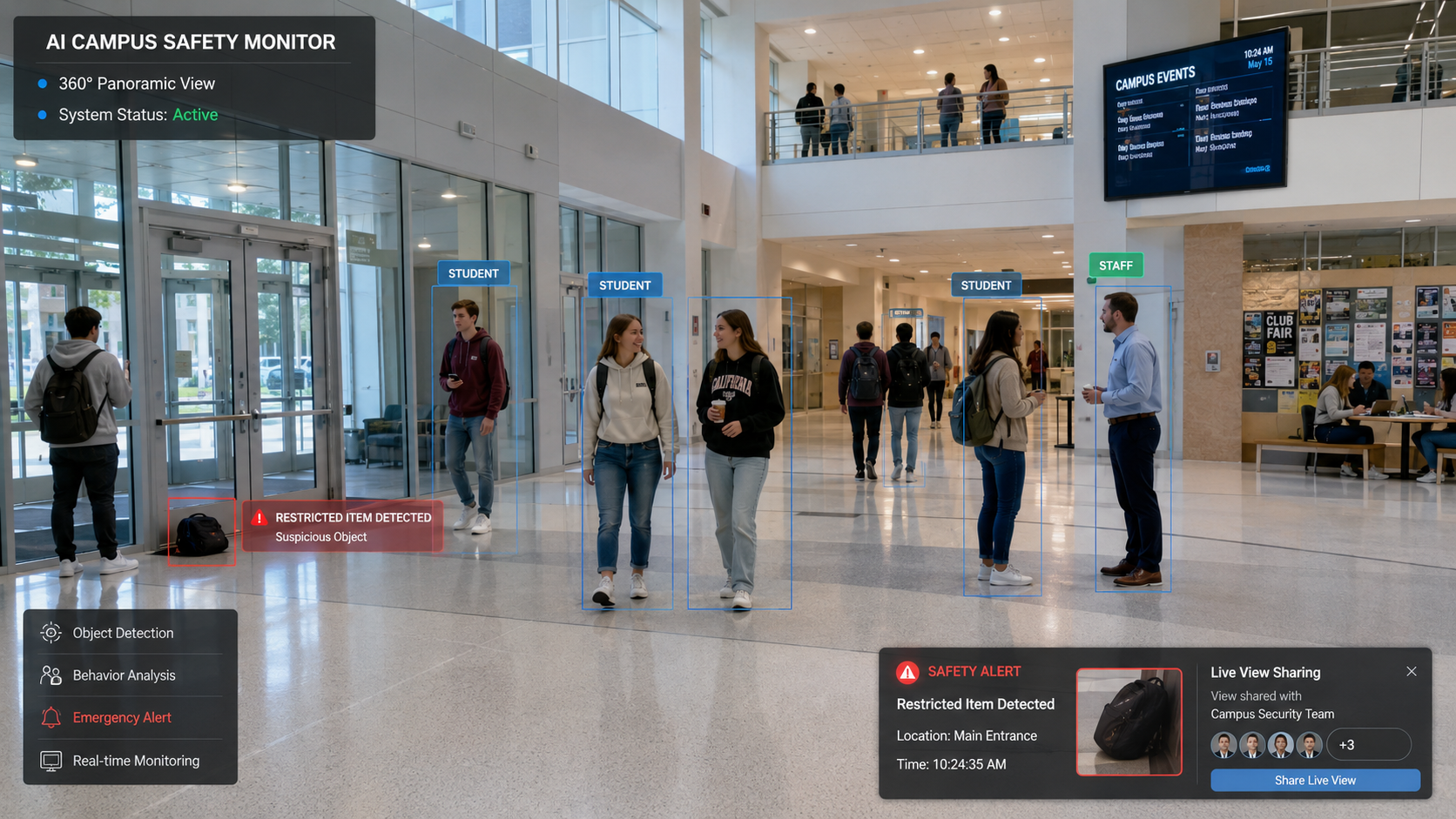
AI-assisted detection can add another layer of support to campus safety systems. Instead of waiting for someone to manually notice every abnormal situation, AI can help identify selected risk signals and notify staff when attention is needed.


For example, AI object detection may support the identification of dangerous objects such as weapons or sharp objects in public areas. AI can also be configured to detect unusual movement, restricted-area access, crowd gathering, or other abnormal events based on the school’s safety policy and local regulations.


The goal is not to replace teachers, security staff, or administrators. The goal is to help them respond earlier with better information.


When a potential risk is detected, the system can send alerts to authorized staff and provide a live view or shared image of the relevant area. This helps teams quickly understand where the issue is happening, evaluate the situation, and decide the next step.

In urgent moments, faster awareness can make a real difference.

Supporting Incident Review and Accountability

Campus monitoring is not only useful during an event. It can also help after an incident has occurred.


When conflicts, accidents, property damage, or disputes happen on campus, schools often need to understand what actually took place. A wider visual record can help administrators review the timeline, clarify responsibility, and reduce misunderstandings between students, parents, teachers, and staff.


This is especially important in situations where different people remember the event differently. Video context can support a more objective review process and help schools make fairer decisions based on evidence rather than assumptions.


However, this should be handled carefully. Access to footage should be limited to authorized personnel, and incident review should follow clear school policies.

Balancing Safety and Privacy in Schools

Campus safety monitoring must be designed with privacy in mind. Schools are sensitive environments, and monitoring should never feel like constant personal surveillance.


A responsible approach should focus on public and safety-critical areas such as entrances, hallways, parking lots, playgrounds, sports areas, and other shared spaces. Private spaces such as restrooms, changing rooms, counseling rooms, and personal areas should never be monitored.


Schools should also define clear rules for data access, video retention, alert handling, and incident review. The purpose of AI-assisted monitoring should be transparent: to support safety, emergency response, and fair incident review, not to track individual behavior without reason.


Trust matters. A good campus safety system should protect people while respecting the boundaries of privacy.

How Panoramic Vision Supports Safer Campus Environments

Schools need to be safe places for students, teachers, and staff. As campus environments become more complex, safety monitoring should move beyond fragmented camera views and passive recording.


AI detection and 360° panoramic vision can help schools identify risks earlier, understand incidents faster, and respond with better context. At the same time, these systems must be deployed with clear privacy boundaries, responsible access control, and transparent policies.For schools, panoramic vision and AI detection can work together to create a more complete safety monitoring approach. Panoramic cameras can provide wider visual coverage, while AI can help highlight selected risks that require attention.

This combination can support campus teams in several ways:

  • Reducing blind spots in public areas
  • Helping staff understand incidents with more context
  • Supporting faster alerts for potential risks
  • Improving emergency response coordination
  • Providing clearer records for post-incident review
  • Helping schools design safer monitoring coverage

Campus safety is not about watching everyone all the time. It is about making sure that when something dangerous happens, the school has the visibility, context, and response tools needed to act quickly and responsibly.


The future of campus safety is not about more surveillance. It is about better awareness, faster response, and safer learning environments.

Conclusion

Schools need to be safe places for students, teachers, and staff. As campus environments become more complex, safety monitoring should move beyond fragmented camera views and passive recording.


AI detection and 360° panoramic vision can help schools identify risks earlier, understand incidents faster, and respond with better context. At the same time, these systems must be deployed with clear privacy boundaries, responsible access control, and transparent policies.


The future of campus safety is not about more surveillance. It is about better awareness, faster response, and safer learning environments.


Related Resources


Related Articles

July 6, 2026
Explore how 360° panoramic cameras and AI detection can support bear detection, wildlife monitoring, outdoor safety, and safer field awareness in Japan and beyond.
June 11, 2026
Explore why AI drowning detection systems need full poolside visibility, better coverage design, and human-AI collaboration to support safer swimming pool environments.