

August 10, 2026
How to Quickly Estimate Effective Pixels for 360° Panoramic Cameras
Author
Supporting AI-Enabled Monitoring Across Different Sites
A practical method for estimating whether a 360° panoramic camera has enough pixel coverage for AI detection, remote monitoring, and deployment planning.
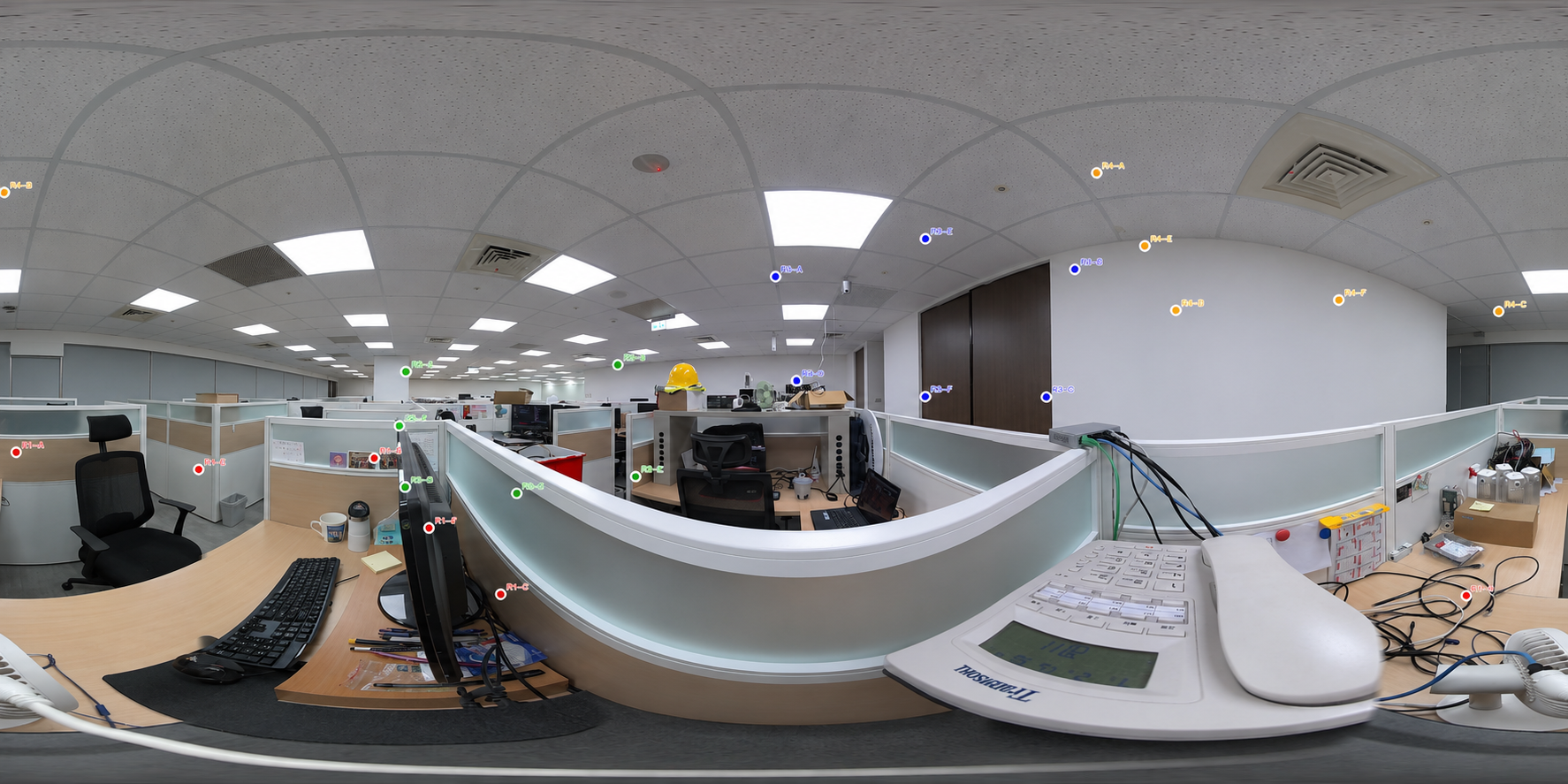
When planning smart factory, smart building, data center, or robotic inspection projects, one of the most common questions is: how far can a 360° panoramic camera see?
In practical discussions, this question often becomes more specific:
- Can the camera detect a person at a certain distance?
- Where should the camera be installed?
- Is the current resolution enough for AI detection?
- How far can the system identify or track a target object?
These questions cannot be answered by resolution alone. What matters most for AI detection and visual verification is how many pixels the target object occupies in the image.
This is where effective pixels become important.
For 360° panoramic vision, effective pixel estimation provides a simple way to evaluate whether a camera setup is suitable for a specific application. By knowing the camera resolution, the real-world size of the target object, and the distance between the camera and the object, project teams can quickly estimate whether the object will appear large enough in the image for detection or review.
Why Effective Pixels Matter
In video surveillance and monitoring projects, camera specifications are often compared by resolution: 2MP, 4K, 8MP, or higher. However, resolution alone does not determine detection performance.
With the same 4K image, a target object far away from the camera may occupy only a small number of pixels. If the same object is closer to the camera, it will occupy more pixels and provide more visual detail.
AI models do not directly analyze “distance.” They analyze image features. If the target object is too small in the image, lacks edge definition, or does not contain enough detail, detection performance may decrease.
For this reason, camera planning should not only ask “how far can the camera see?” A more useful question is: how many effective pixels does the target object have at that distance?
Effective pixel estimation can help system integrators and customers evaluate:
- Whether the camera installation distance is suitable
- Whether the object appears large enough in the image
- Whether the image provides a basic condition for AI detection
- Whether higher resolution, shorter distance, or additional cameras are needed
- Whether a dedicated camera, such as an LPR camera, should be used for specific tasks
Estimation Logic for 360° Panoramic Images
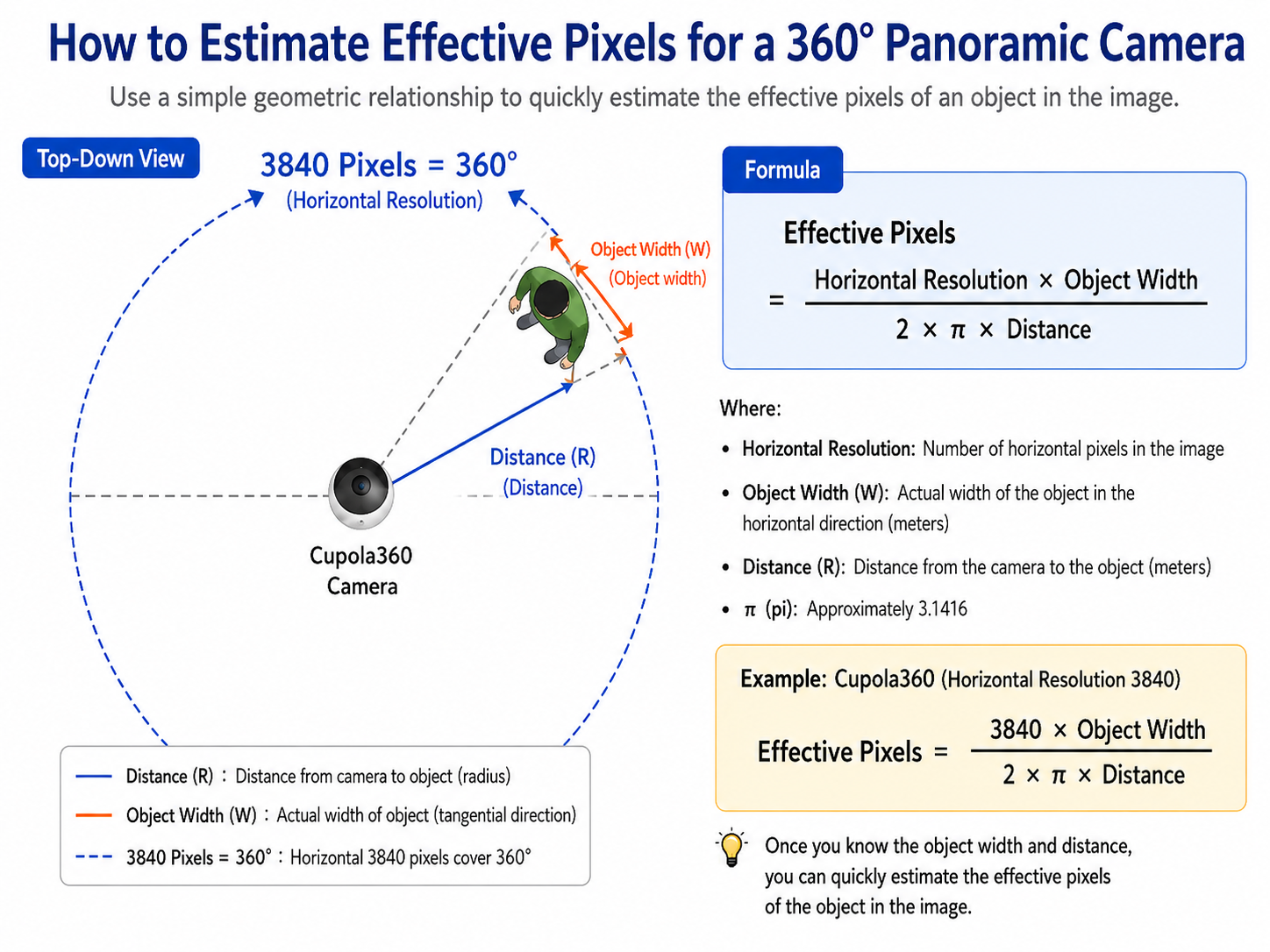
For an equirectangular 360° panoramic image, the horizontal resolution represents the full 360° field of view. In other words, the horizontal pixels are distributed around the entire circle surrounding the camera.
A simple way to estimate effective pixel width is to treat the distance from the camera to the object as the radius of a circle. The real-world width of the object occupies a portion of the circle’s circumference. That same proportion can be applied to the horizontal resolution of the panoramic image.
The quick estimation formula is:
Effective Pixel Width = Horizontal Resolution × Object Width ÷ (2 × π × Distance)
For a Cupola360 3840 × 1920 panoramic camera, the horizontal resolution is 3840 pixels. The formula becomes:
Effective Pixel Width = 3840 × Object Width ÷ (2 × π × Distance)
To use this estimation, you need three values:
- Camera horizontal resolution
- Real-world object width
- Distance between the camera and the object
This is a quick estimation method for early-stage project planning. Actual performance may still be affected by installation height, camera angle, lighting, object pose, occlusion, compression, AI model capability, and system configuration.
Example 1: Person Detection
Assume the approximate width of an adult person is 0.5 meters. With a 3840 × 1920 360° panoramic image, the estimated effective pixel width is:
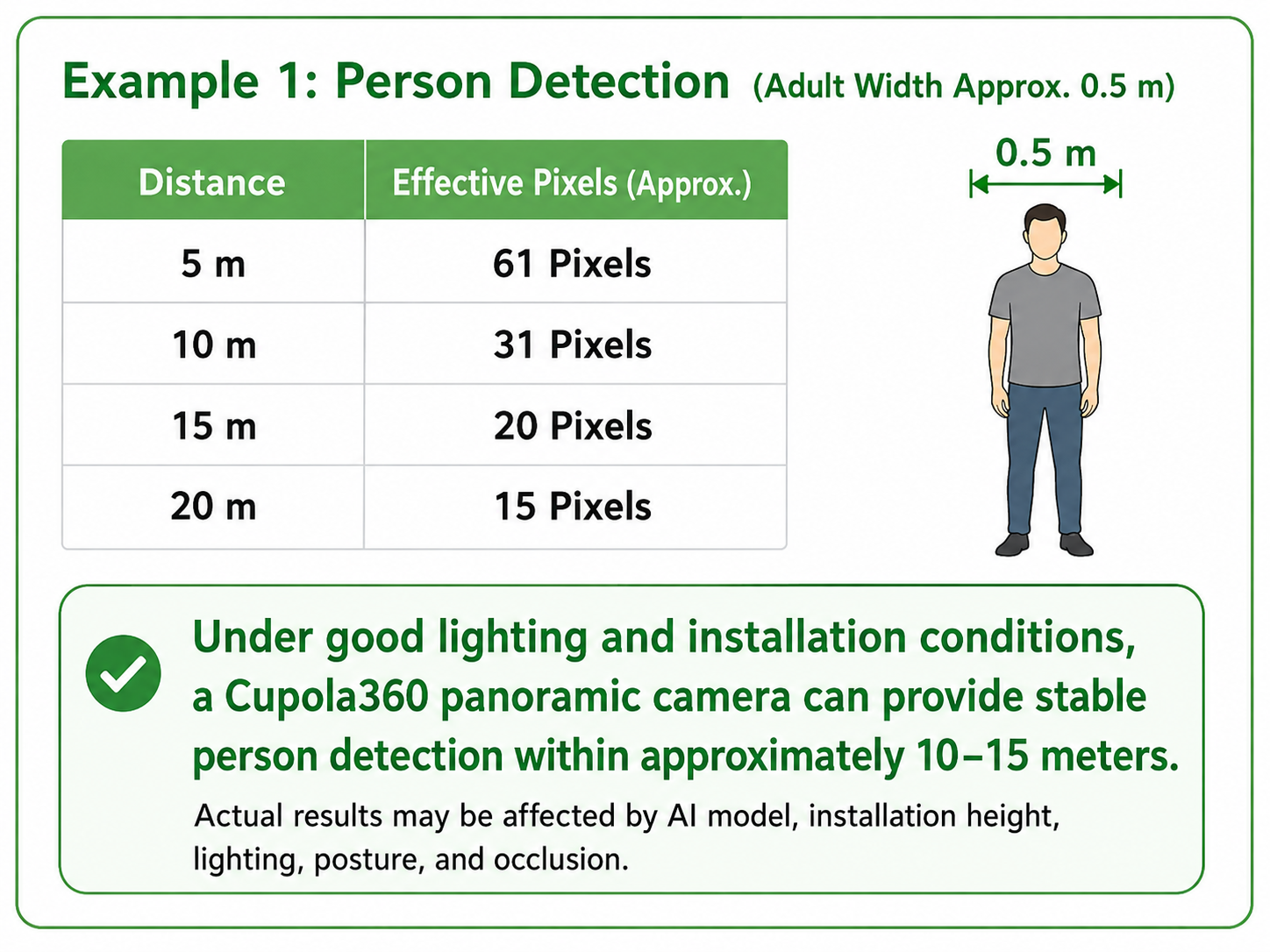
The result shows that effective pixel width decreases quickly as distance increases. In practical applications, a 3840 × 1920 panoramic camera can generally provide more stable conditions for person detection within approximately 10 to 15 meters.
This does not mean detection becomes impossible beyond 15 meters, nor does it guarantee perfect detection within 10 meters. Actual results still depend on installation height, human posture, movement speed, lighting, occlusion, background complexity, and AI model design.
Effective pixel estimation should be used as an initial planning reference, not as the only performance criterion.
Example 2: License Plate Recognition
For a standard passenger vehicle license plate in Taiwan, assume the plate width is approximately 0.38 meters. With the same 3840 × 1920 360° panoramic image, the estimated effective pixel width is:
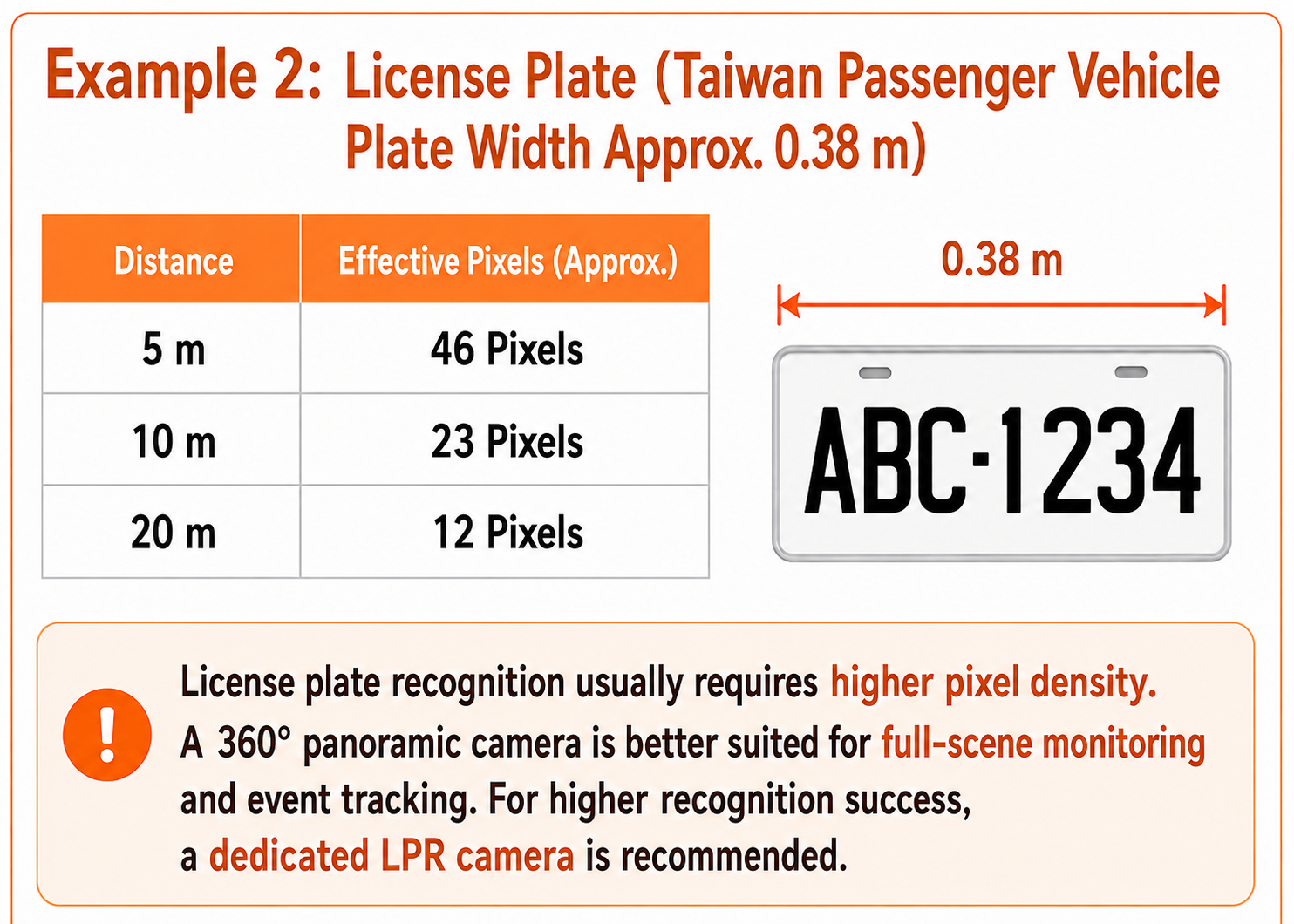
License plate recognition usually requires higher pixel density and more controlled imaging conditions, including proper angle, sufficient resolution, shutter speed, illumination, low compression, and an algorithm designed specifically for LPR.
For this reason, 360° panoramic cameras are better suited for full-scene monitoring, event awareness, and vehicle movement context. If the project requires high-success-rate license plate recognition, a dedicated LPR camera is still recommended. The 360° panoramic camera can then provide the surrounding scene context and event-level awareness.
Using Effective Pixels for Camera Deployment Planning
Effective pixel estimation can help project teams quickly evaluate whether a proposed camera layout is reasonable.
In a smart factory, for example, if the goal is to detect whether a person enters a restricted or hazardous area, system integrators can estimate the effective pixel width of a person at different distances. This helps determine whether the camera should be installed closer to entrances, production lines, or safety zones.
In data centers and equipment rooms, if the goal is to monitor aisles, personnel movement, or equipment zones, effective pixel estimation can help avoid placing the camera too far from critical areas.
In robotic inspection applications, 360° panoramic cameras can provide surrounding visual awareness, while effective pixel estimation helps determine whether objects at different distances have enough image detail for detection or review.
This method is useful for:
- Initial camera placement planning
- AI detection distance estimation
- Camera resolution selection
- Feasibility checks before site testing
- Discussion of expected coverage with customers
- Deciding whether additional dedicated cameras are needed
Important Considerations
Effective pixels provide a practical estimation, but they do not replace on-site testing.
Actual detection performance may be affected by many factors, including:
- Camera installation height and tilt angle
- Whether the object faces the camera
- Lighting conditions and night illumination
- Motion blur and shutter speed
- Compression level and streaming quality
- Occlusion
- Background complexity
- AI model type and training data
- Detection target, such as people, vehicles, PPE, license plates, or other objects
The value of effective pixel estimation is that it provides a first-level technical reference. It helps teams narrow down deployment options, identify reasonable camera positions, and select suitable camera specifications before validating the design on site.
Conclusion
Effective pixel estimation is a simple but useful concept. By using object size, camera horizontal resolution, and distance, project teams can quickly estimate the approximate pixel width of a target object in a 360° panoramic image.
For smart factories, smart buildings, data centers, public spaces, and robotic inspection applications, this method helps system integrators and customers plan camera selection and deployment more efficiently.
Instead of asking only “how far can a 360° panoramic camera see?”, a more accurate question is: at this distance, does the target object still have enough effective pixels for detection and visual review?
In future technical articles, we will continue to share more topics related to 360° panoramic vision, including DORI, Pixels Per Meter (PPM), AI detection distance, and panoramic camera installation design.
Related Articles